In Conversation with:
Ambassadors on their priorities, their countries and their vision for Germany
Click a name to read the full conversation
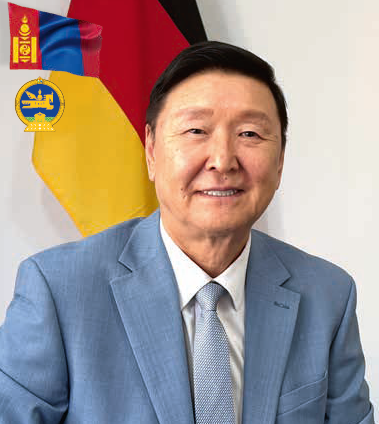 Ambassador of Mongolia
H.E. Jagdag Oyunbaatar
“Modern Mongolia”
Ambassador of Mongolia
H.E. Jagdag Oyunbaatar
“Modern Mongolia”
“Modern Mongolia”
- DM: Your Excellency, what will be at the very top of your agenda during your tenure as Ambassador to Germany?
- H.E. Jagdag Oyunbaatar: As Ambassador, my priority would be to turn the strong political understanding and mutual trust between Mongolia and Germany into tangible results. I would promote German investment, technology and know-how in manufacturing, renewable energy, AI, agriculture and tourism, while connecting Mongolian businesses with innovative German SMEs. I would also strengthen cooperation in education, vocational training and science, creating new opportunities for young people. Success, in my view, should be measured by concrete projects, investment, skills transferred and stronger ties between our peoples.
- DM: How would you ideally like your country to be perceived in Germany and across Europe?
- H.E. Jagdag Oyunbaatar: Mongolia has a rich history and cultural heritage, from the Hunnu and Mongol Empires to its enduring nomadic traditions. The “Chinggis Khaan and the World of the Mongols” exhibition in Berlin is a valuable opportunity for Europeans to discover this heritage. At the same time, modern Mongolia should be recognised not simply as a resource-rich country, but as a democratic, peaceful and reliable partner committed to human rights, the rule of law and an independent, multi-pillar foreign policy. We seek lasting partnerships with Europe based on shared values and mutual interests.
- DM: How will you communicate your priorities and agenda?
- H.E. Jagdag Oyunbaatar: Public diplomacy is an essential part of modern diplomacy. I would maintain open, professional and regular engagement with Germany’s major media and specialized publications, ensuring that accurate and balanced information about Mongolia is readily available. I want Mongolia to be understood not only through politics and mining, but also through its democracy, economic and technological potential, young people, culture and nomadic heritage. I would encourage more German journalists to visit Mongolia and report firsthand. Our aim is not to promote an image, but to help people understand Mongolia better through openness, facts and direct experience.
DM: Your Excellency, thank you very much.
Photo © Embassy of Mongolia
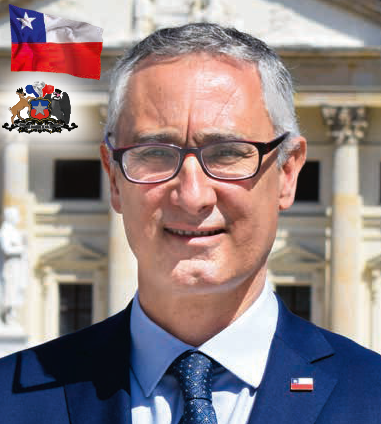 Ambassador of the Republic of Chile
H.E. Jorge Eduardo Sandrock Carrasco
“Strengthening Our Economic Relations”
Ambassador of the Republic of Chile
H.E. Jorge Eduardo Sandrock Carrasco
“Strengthening Our Economic Relations”
“Strengthening Our Economic Relations”
- DM: Your Excellency, what will be at the very top of your agenda during your tenure as Ambassador to Germany?
- H.E. Jorge Eduardo Sandrock Carrasco: Chile and Germany share a highly diverse bilateral agenda. Every aspect of our ties is important, and our mission will be to preserve and deepen them. However, a top priority will be the effort to strengthen our economic relations by attracting more German investment to Chile and opening new markets for our exports.
- DM: How would you ideally like your country to be perceived in Germany and across Europe?
- H.E. Jorge Eduardo Sandrock Carrasco: Our goal is to ensure that Chile is perceived for what it is: a reliable partner committed to the rule of law and with very solid institutions that guarantee legal certainty. A country whose foreign policy is based on the principles of defending democracy and human rights, free trade and open markets, as well as multilateralism and a rules-based international order. And, of course, a wonderful tourist destination with a highly diverse landscape and first-rate infrastructure and services.
- DM: How will you communicate your priorities and agenda?
- H.E. Jorge Eduardo Sandrock Carrasco: I prefer a traditional approach to communication, establishing personal contact with the various parties involved. The idea is to carry out a very intensive schedule of meetings with different stakeholders involved in our bilateral relationship and decision-makers so that we can personally convey our priorities and objectives. This also involves a very dynamic schedule that includes visits to different locations throughout Germany. At the same time, we will maintain active and transparent communication through the Embassy’s official channels — especially our social media accounts — so that both the Chilean community living in Germany and German citizens with ties to Chile can stay informed about our priorities, the initiatives we are promoting, and the progress we are making during this new term.
DM: Your Excellency, thank you very much.
Photo © Embassy of Chile
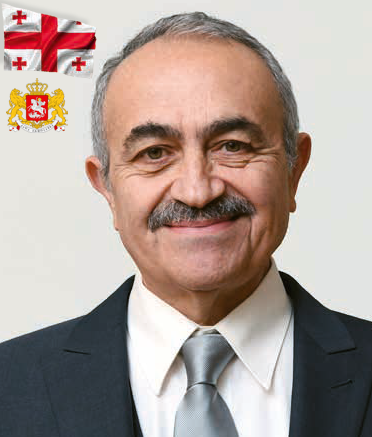 Ambassador of Georgia
H.E. Prof. Dr. Aleksandre Kartozia
“1,700 Years of Christianity”
Ambassador of Georgia
H.E. Prof. Dr. Aleksandre Kartozia
“1,700 Years of Christianity”
“1,700 Years of Christianity”
- DM: Your Excellency, what will be at the very top of your agenda during your tenure as Ambassador to Germany?
- H.E. Prof. Dr Aleksandre Kartozia: Germany and Georgia share a long-standing tradition of friendly relations. As early as the first third of the 19th century, more than 20 settlements of immigrants from Germany were established in Georgia. The Germans were welcomed with great warmth in their new homeland. German culture was held in particularly high regard in Georgia, and the German language was studied intensively. Furthermore, Germany was the first country to recognize Georgia’s independence in 1918, as well as the first country to establish diplomatic relations with Georgia following the collapse of the Soviet Union. For decades, Germany has been Georgia’s reliable partner in Europe, and Georgia has been Germany’s reliable partner in the Caucasus. We are grateful for Germany’s long-standing assistance and comprehensive support, which paved the way for us to attain the status of an EU candidate country. Today, as relations between Germany and Georgia face numerous problems and challenges, I consider it my duty to contribute, as much as possible, to reviving and deepening the historic friendship and partnership between our two countries.
- DM: How would you ideally like your country to be perceived in Germany and across Europe?
- H.E. Prof. Dr Aleksandre Kartozia: It is my hope that an accurate picture of Georgia will take hold in Germany and throughout Europe. The country, which this year is celebrating the 1,700th anniversary of the proclamation of Christianity as the state religion and which has always been distinguished by its tolerance toward other ethnic groups and religions, sees itself as a natural part of the European family. Since the war with Russia, one-fifth of the country’s territory has been under occupation; therefore, the peaceful restoration of territorial integrity is Georgia’s top political priority. Geographically, politically, and culturally, Georgia has served as a bridge between East and West since ancient times. The current global political situation has made Georgia’s importance for the connectivity between Asia and Europe even more evident.
- DM: How will you communicate your priorities and agenda?
- H.E. Prof. Dr Aleksandre Kartozia: It is important to expand cooperation with representatives of regional and national mass media, to give lectures at universities and before interested institutions and organizations, and to participate in think tank meetings and conferences. I also place great importance on supporting the organization of cultural events - concerts, exhibitions, film screenings, literary events, and, last but not least, culinary presentations and tastings. I also consider it extremely important to deepen relationships between sister cities and to establish new partnerships between cities and regions. A country with a rich culture and attractive to tourists year-round; a country recognized by UNESCO as the cradle of winemaking and known for its hospitality; a country through which the shortest route between Asia and Europe runs - this is the country whose “rediscovery” would be an asset to both Germany and all of Europe.
DM: Your Excellency, thank you very much.
Photo © Mohammad El Saai
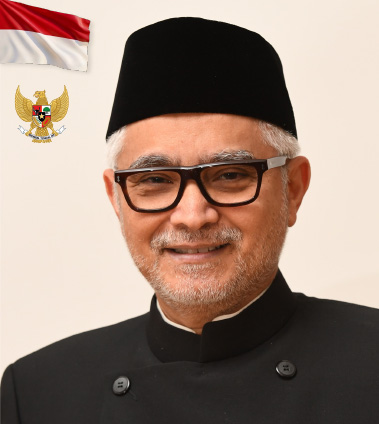 Ambassador of the Republic of Indonesia
H.E. Abdul Kadir Jailani
“Vast Potential to Deepen Cooperation”
Ambassador of the Republic of Indonesia
H.E. Abdul Kadir Jailani
“Vast Potential to Deepen Cooperation”
“Vast Potential to Deepen Cooperation”
- DM: Your Excellency, what will be at the very top of your agenda during your tenure as Ambassador to Germany?
-
Ambassador Jailani: My foremost priority is to elevate the Indonesia–Germany partnership to a higher strategic level. As the leading economies of Southeast Asia and the EU, both countries have vast potential to deepen cooperation in the green economy, renewable energy, sustainable industrialization, digital transformation, and advanced manufacturing. Indonesia’s energy transition and Germany’s expertise in clean technologies provide a strong foundation, including through JETP. Human capital development will remain central through vocational education, workforce mobility, and higher education, particularly in semiconductors, AI, and advanced engineering. I also aim to strengthen people-to-people ties, diaspora engagement, and exchanges among universities, research institutions, cities, and cultural organizations. Berlin’s strategic position offers unique opportunities to advance both bilateral priorities and broader Indonesia–EU cooperation, including the successful conclusion and implementation of the IEU-CEPA.
- DM: How would you ideally like your country to be perceived in Germany and across Europe?
-
Ambassador Jailani: Indonesia is widely known for its natural beauty and rich cultural diversity, but I would like Germany and Europe to see Indonesia in a broader and more contemporary light. As the world’s third-largest democracy, Southeast Asia’s largest economy, and home to over 280 million people, Indonesia is a young, dynamic, and increasingly innovative nation undergoing major economic transformation. Through downstream industrialization, digital transformation, and green development, we are strengthening our role as a hub for manufacturing, innovation, renewable energy, and sustainable growth. Indonesia is also projected to become one of the world’s largest economies in the coming decades. Guided by an independent and active foreign policy, we promote dialogue, inclusivity, multilateralism, international law, and peaceful solutions. These shared values provide a strong foundation for Indonesia and Germany to advance stability, economic openness, sustainable development, and international cooperation.
- DM: How will you communicate your priorities and agenda?
-
Ambassador Jailani: I look forward to engaging with a broad range of German media, including public broadcasters, national newspapers, business publications, and international affairs outlets, to foster a deeper understanding of Indonesia. Equally important are Germany’s universities, research institutions, foundations, and think tanks, particularly in Berlin, which are essential partners in strengthening long-term ties. My approach will be one of proactive engagement, promoting sustained dialogue on Indonesia’s transformation and opportunities for closer cooperation. Key themes include economic modernization, energy transition, critical minerals, sustainable supply chains, semiconductors, digital transformation, food security, maritime cooperation, and international peace and security. Germany’s technological strengths and Indonesia’s demographic dynamism, growing middle class, and Indo-Pacific position create strong complementarities. My message is simple: Indonesia and Germany are natural partners in addressing the defining challenges of the 21st century through innovative and sustainable cooperation.
DM: Your Excellency, thank you very much.
Photo © Mohamed El Sauaf
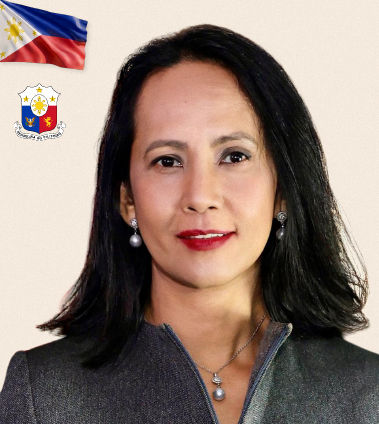 Ambassador of the Republic of the Philippines
H.E. Maria Teresa Torres Almojuela
“A Like-Minded Partner in the Indo-Pacific”
Ambassador of the Republic of the Philippines
H.E. Maria Teresa Torres Almojuela
“A Like-Minded Partner in the Indo-Pacific”
“A Like-Minded Partner in the Indo-Pacific”
- DM: Your Excellency, what will be at the very top of your agenda during your tenure as Ambassador to Germany?
-
Ambassador Torres Almojuela: At our National Day reception on 5 May, State Minister Florian Hahn called the Philippines a “prime partner” of Germany. That speaks of Berlin’s confidence in the Philippines and how it sees the opportunities in, and trajectory of, our relations. Manila is as enthusiastic about our ties. I wish to keep the momentum high and advance outcomes of recent high-level exchanges, including the 2024 visit of President Marcos Jr.
Germany’s role as a leading European partner gives this post particular weight, with a new defense agreement, and an FTA with EU and the 75th year of our ties in the horizon.
- DM: How would you ideally like your country to be perceived in Germany and across Europe?
-
Ambassador Torres Almojuela: I would like Germans to see the Philippines not only as a country of warmth and natural beauty, but also a like-minded partner in the Indo-Pacific and a democracy committed to multilateralism and the global rules-based order.
I would like the German public to appreciate us as a country navigating complex geopolitical realities with strategic clarity and an independent foreign policy. We have 113 million people, a vibrant economy and a rich culture. Our heritage as a maritime nation, as Asia’s first Republic, and founding member of the UN and ASEAN, is central to our identity and diplomacy.
- DM: How will you communicate your priorities and agenda?
-
Ambassador Torres Almojuela: The Philippines was celebrated as the Guest of Honor of the 2025 Frankfurt Buchmesse. This put a spotlight on Filipino literature and culture, serving as a bridge for the German public to understand my nation from a modern lens. I hope to sustain the goodwill it generated with engagements through traditional and social media. We tell stories to spark interest and build real connection. Part of this are our national hero Dr. Jose Rizal, who lived here in the 1880s, and the over 40,000 Filipinos in this country who communicate who we are as a people to the Germans they meet on a daily basis.
DM: Your Excellency, thank you very much.
Photo © Private