Embassies in the Diplomatic District
The Japanese Embassy in Berlin: A Cornerstone of Diplomatic Architecture
4 January 2026
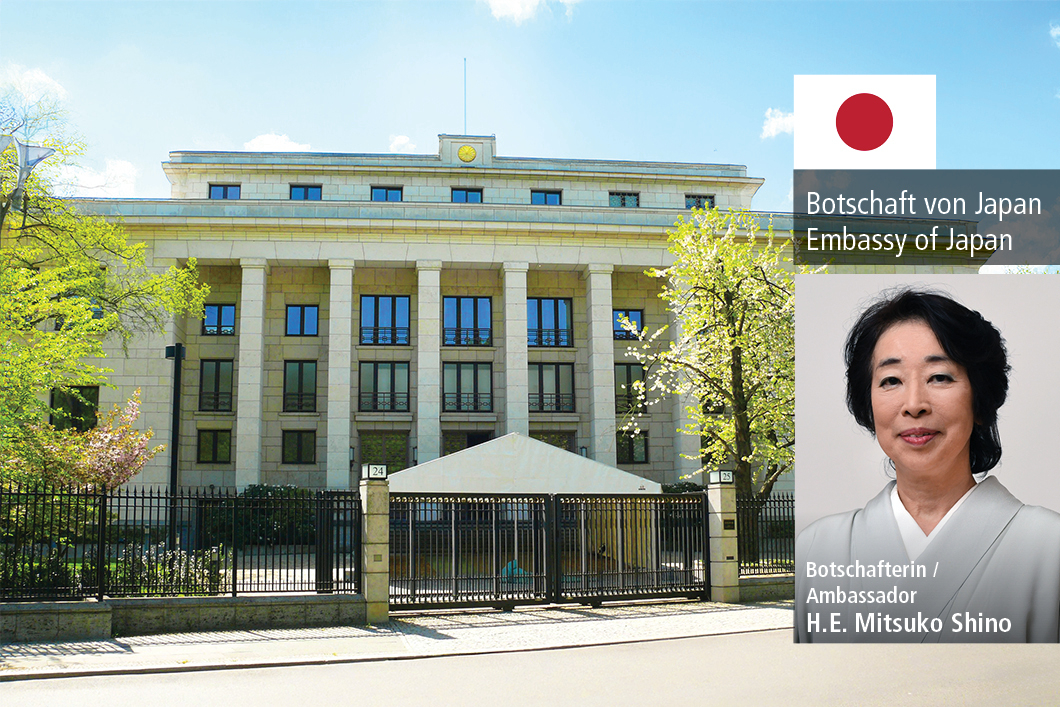
在ドイツ日本国大使館
Represented by H.E. Mitsuko Shino, Ambassador of Japan since November 2024.
Further Reading in Print: Explore further Embassies of Berlin’s Tiergarten District in our 01/02 2026 Print Edition, under “The History of Berlin’s Diplomatic District” starting on page 8.
Explore the Japanese Embassy in Berlin’s Tiergarten. From its 1938 Axis roots to Kishō Kurokawa’s modern Zen redesign, discover a cornerstone of diplomatic history and its complex architectural and political history.
Highlights
The “Axis” Architecture
Designed by Ludwig Moshamer (1938–1942). It was built to architecturally mirror the Italian Embassy across the street, symbolising the Rome-Berlin-Tokyo axis.
The Reconstruction Symbiosis
The 1980s restoration led by Kishō Kurokawa, which blended the original neoclassical facade with contemporary Zen-style gardens and Bauhaus-inspired interior elements.
Diplomatic Symbolism
The Imperial Chrysanthemum crest above the entrance which symbolizes the Emperor and the Japanese Imperial Family and the cherry tree planted by the Crown Prince (now Emperor) Naruhito to signify enduring German-Japanese relations)
In the Interwar Period and World War II
During the interwar period and World War II, Japan was closely aligned with Germany, a relationship that is also reflected in the construction of the former embassy building.
From Bonn to Berlin
In 1952, diplomatic relations with the Federal Republic of Germany were reestablished. Following the relocation of the German government to Berlin, the Japanese Embassy was permanently moved from Bonn back to its historic location in Berlin-Tiergarten.
Built 1938–1942
The original monumental classical building with its strict façade articulation, constructed between 1938 and 1942, is characteristic of the official representative style of the Nazi regime, as are the large columns at the main entrance. The building was conceived as a prestige project to demonstrate the political alliance between Japan and Nazi Germany. Heavily damaged during World War II, it stood vacant for many decades after the war.
German-Japanese Society
Before the fall of the Berlin Wall, the building was only partially usable, mainly by the German-Japanese Society. Commissioned by both governments, the severely dilapidated structure was reconstructed between 1985 and 1988 as a German-Japanese Center, closely following the original plans, under the direction of architects Kishō Kurokawa and Tajii Yamaguchi. Ten years later, it was remodeled and expanded again, with the addition of a service building and a Japanese garden. The main entrance was relocated from Tiergartenstraße to Hiroshimastraße.
Japanese Embassy
Since the turn of the millennium, following comprehensive modernization, the monumental classical building has once again housed the Embassy of Japan. For the opening, the Emperor’s son traveled to Berlin and planted a cherry tree in front of the embassy, which has since grown into a respectable tree. The embassy building represents political presence and diplomatic dignity. The state and imperial dignity of Japan is symbolized by the chrysanthemum above the entrance—the exclusive emblem of the Japanese imperial family.
The embassy features large reception and representative rooms used for official events, receptions, and diplomatic meetings. The consular section is integrated into the embassy building.
Address
Embassy of Japan in Germany
Hiroshimastraße 6
10785 Berlin
https://www.de.emb-japan.go.jp/