The Hanseatic City of StendalWhere the Middle Ages Meet Modern Times
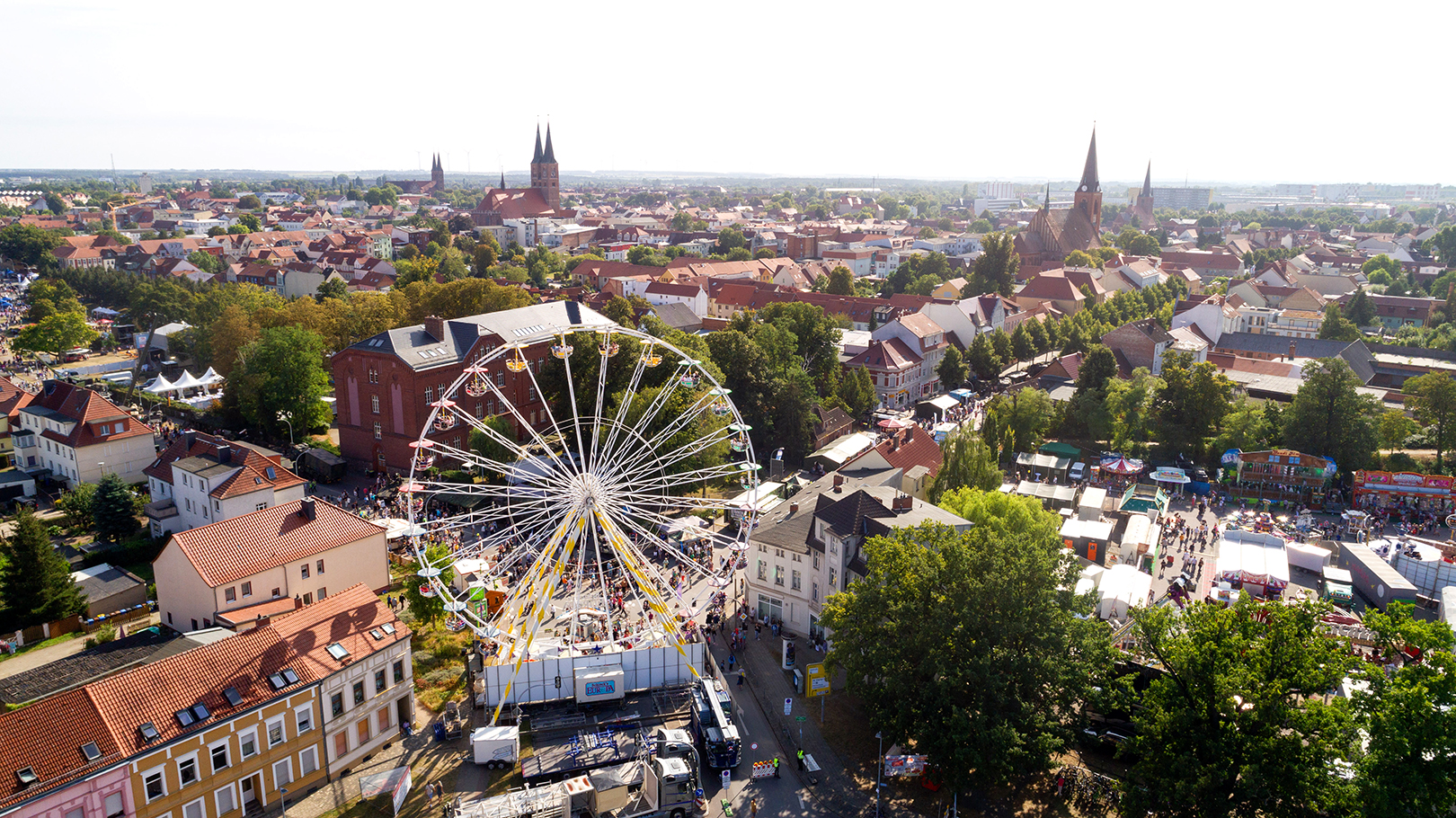
Aerial view from the Schützenplatz over Stendal’s historic church towers
The Hanseatic city of Stendal is the vibrant heart of the scenically beautiful Altmark region. This “Roland town” in northern Saxony-Anhalt is home to a university, an important transport hub in central Germany, and, above all, a lovable and highly liveable place with a fascinating history.
Around 1160, Margrave “Albrecht the Bear” granted the town market rights and exemption from tolls, and a marketplace with simple trading stalls sprang up. Shortly afterwards, the oldest department store north of the Alps was built on what is now the market square. The 50-metre-long “domus mercatorum”, dating from the early 12th century, can now be experienced digitally and in faithful detail.
Anyone strolling through the old town encounters many testimonies of times gone by. Germany’s third-largest Roland statue – a 7.80-metre-high knight’s monument – stands in the market square in front of the Gothic Gerichtslaube (court arcade). Inside the town hall, visitors marvel at a late Gothic carved wooden wall from 1462, considered the oldest secular carved wall north of the Alps.
The 82-metre-high towers of St Mary’s, the town and council church, dominate the skyline of Stendal’s market square. In the choir of the late Gothic church stands the high altar of 1471, one of the most magnificent altars of its time in northern Germany, depicting the story of Mary. The town’s former council church is an architectural expression of the pride and wealth of Stendal’s Hanseatic merchants.
The Tangermünde Gate and the Uenglingen Gate – considered one of the most beautiful brick gates in northern Germany – are also impressive testimonies to the Hanseatic League’s heyday from the 13th to the 15th century.
The two surviving gate structures bear witness to Stendal’s former town fortifications. Climbing the Uenglingen Gate, the view opens eastward onto the heart of the city, with its church spires reaching for the sky. Alongside the twin towers of St Mary’s, further towers punctuate the city’s skyline: the spire of the oldest surviving church, St Peter’s, with its four corner turrets, dates from 1583. The tower of St James’s Church was built between 1893 and 1901. St Nicholas’s Cathedral is distinguished by two towers, and its interior impresses with 22 stained-glass windows.
Stendal scores points not only with its rich past but also with plenty to offer culturally: the popular Theater der Altmark enjoys renown well beyond the region. In the former monastery garden, now the Musikforum, open-air concerts are held regularly in summer in this uniquely atmospheric setting.
More information: www.stendal-tourist.de
A Welcome from the Mayor
Dear readers,
As Mayor, I warmly invite you to discover the Hanseatic city of Stendal, just outside the gates of Berlin. Here, the Middle Ages meet modern times: our historic buildings bear witness to the Hanseatic League’s golden age, while the vibrant town centre invites you to stroll and promises cultural enjoyment. You will find our municipal tourist information office in the historic town hall on the market square, where you can obtain all the information you need, both before and during your stay. We look forward to your visit!
Bastian Sieler, Mayor of the Hanseatic City of Stendal
Day-Trip Tip – Family Museum of the Winckelmann Society
The world’s largest “Trojan Horse” is 15.60 metres tall, can be entered – and it stands in Stendal. It is located in the garden of the Winckelmann Museum. The Stendal museum draws on Winckelmann’s legacy – the sensory, hands-on experience of ancient culture – and invites visitors to its Family Museum for an active immersion in antiquity. The Winckelmann Museum also offers a modern, barrier-free exhibition concept and is dedicated to the life and work of Johann Joachim Winckelmann (1717–1768). As the founder of classical archaeology and art history, Winckelmann is regarded as the most famous “son” of the Hanseatic city of Stendal.
‘Domus Mercatorum’ Digital: The Oldest Department Store North of the Alps on Stendal’s Market Square
As early as 1188, records mention a “domus mercatorum”, a medieval department store, in Stendal. Thanks to archaeological findings, the structure of this building can be reconstructed in precise detail. Building on these archaeological findings and historical sources, the Hanseatic city of Stendal, together with the engineering firm GEO-METRIK-Ingenieurgesellschaft mbH Stendal and the LDA Saxony-Anhalt (State Office for Heritage Management and Archaeology), has created an augmented reality application. Using a tablet and/or smartphone, it allows today’s visitors to experience the dimensions and appearance of the department store as if it were real, right at its original historical location.